
Emmerich, S. D., Fryar, C. D., Stierman, B. & Ogden, C. L. 2024 obesity and severe obesity prevalence in adults: United States, August 2021–August 2023. NCHS Data Brief. 508, 1–9 (2024).
Zhao, Z. & Liu, W. Pancreatic cancer: a review of risk factors, diagnosis, and treatment. Technol. Cancer Res. Treat. 19, 1533033820962117 (2020).
Google Scholar
Wei, J. et al. Estimating global prevalence of mild cognitive impairment and dementia in elderly with overweight, obesity, and central obesity: a systematic review and meta-analysis. Obes Rev. 25, e13882 (2024).
Xiang, Q. et al. Cellular and molecular mechanisms underlying obesity in degenerative spine and joint diseases. Bone Res. 12, 71 (2024).
Google Scholar
Alenezi, M. A. et al. The association between obesity and the development and severity of obstructive sleep apnea: a systematic review. Cureus 16, e69962 (2024).
Google Scholar
Ndumele, C. E. & American Heart A. Cardiovascular-kidney-metabolic health: a presidential advisory from the American Heart Association. Circulation 148, 1606–1635 (2023).
Most, J. & Redman, L. M. Impact of calorie restriction on energy metabolism in humans. Exp. Gerontol. 133, 110875 (2020).
Google Scholar
Gupta, M. K., Gouda, G. & Vadde, R. Relation between obesity and type 2 diabetes: evolutionary insights, perspectives and controversies. Curr. Obes. Rep. 13, 475–495 (2024).
Google Scholar
Rhee, E. J. Weight cycling and its cardiometabolic impact. J. Obes. Metab. Syndr. 26, 237–242 (2017).
Google Scholar
Archer, E. & Lavie, C. J. Obesity subtyping: the etiology, prevention, and management of acquired versus inherited obese phenotypes. Nutrients 14, 2286 (2022).
Google Scholar
Duncan, G. E. The “fit but fat” concept revisited: population-based estimates using NHANES. Int. J. Behav. Nutr. Phys. Act. 7, 47 (2010).
Google Scholar
Stefanakis, K., Kokkorakis, M. & Mantzoros, C. S. The impact of weight loss on fat-free mass, muscle, bone and hematopoiesis health: Implications for emerging pharmacotherapies aiming at fat reduction and lean mass preservation. Metabolism 161, 156057 (2024).
Google Scholar
Bikou, A., Dermiki-Gkana, F., Penteris, M., Constantinides, T. K. & Kontogiorgis, C. A systematic review of the effect of semaglutide on lean mass: insights from clinical trials. Expert Opin. Pharmacother. 25, 611–619 (2024).
Google Scholar
Loprinzi, P. D. & Tudor-Locke, C. Weight-activity associations with cardiometabolic risk factors among U.S. youth. Physiol. Behav. 149, 165–168 (2015).
Google Scholar
Miller, C. et al. Mechanisms in endocrinology: hypogonadism and metabolic health in men-novel insights into pathophysiology. Eur. J. Endocrinol. 191, R1–R17 (2024).
Google Scholar
Lengton, R., Schoenmakers, M., Penninx, B., Boon, M. & van Rossum, E. F. C. Glucocorticoids and HPA axis regulation in the stress-obesity connection: a comprehensive overview of biological, physiological and behavioural dimensions. Clin. Obes. 15, e12725 (2024).
Google Scholar
Tsatsoulis, A. The role of insulin resistance/hyperinsulinism on the rising trend of thyroid and adrenal nodular disease in the current environment. J. Clin. Med. 7, 37 (2018).
Google Scholar
Webb, R. C. Smooth muscle contraction and relaxation. Adv. Physiol. Educ. 27, 201–206 (2003).
Google Scholar
Vanhoutte, P. M. Endothelial lessons. Curr. Vasc. Pharm. 14, 175–180 (2016).
Google Scholar
Shi, Y. & Vanhoutte, P. M. Macro- and microvascular endothelial dysfunction in diabetes. J. Diab. 9, 434–449 (2017).
Google Scholar
Carlstrom, M., Weitzberg, E. & Lundberg, J. O. Nitric oxide signaling and regulation in the cardiovascular system: recent advances. Pharm. Rev. 76, 1038–1062 (2024).
Google Scholar
Obesity: preventing and managing the global epidemic. Report of a WHO consultation. World Health Organ Tech. Rep. Ser. 894, 1–253 (2000).
Seidell, J. C. Obesity, insulin resistance and diabetes–a worldwide epidemic. Br. J. Nutr. 83, S5–S8 (2000).
Google Scholar
Belin de Chantemele, E. J. & Stepp, D. W. Influence of obesity and metabolic dysfunction on the endothelial control in the coronary circulation. J. Mol. Cell Cardiol. 52, 840–847 (2012).
Google Scholar
Stepp, D. W. Impact of obesity and insulin resistance on vasomotor tone: nitric oxide and beyond. Clin. Exp. Pharm. Physiol. 33, 407–414 (2006).
Google Scholar
Engin, A. Endothelial dysfunction in obesity and therapeutic targets. Adv. Exp. Med Biol. 1460, 489–538 (2024).
Google Scholar
Fulton, D. et al. Insulin resistance does not diminish eNOS expression, phosphorylation, or binding to HSP-90. Am. J. Physiol. Heart Circ. Physiol. 287, H2384–H2393 (2004).
Google Scholar
Harrell, J. W. et al. Preserved microvascular endothelial function in young, obese adults with functional loss of nitric oxide signaling. Front Physiol. 6, 387 (2015).
Google Scholar
Merdzo, I. et al. The mitochondrial function of the cerebral vasculature in insulin-resistant Zucker obese rats. Am. J. Physiol. Heart Circ. Physiol. 310, H830–H838 (2016).
Google Scholar
Thompson, J. A. et al. Genetic deletion of NADPH oxidase 1 rescues microvascular function in mice with metabolic disease. Circ. Res 121, 502–511 (2017).
Google Scholar
Zhang, Q. et al. Paradoxical activation of endothelial nitric oxide synthase by NADPH oxidase. Arterioscler Thromb. Vasc. Biol. 28, 1627–1633 (2008).
Google Scholar
Bagg, W. et al. Effects of improved glycaemic control on endothelial function in patients with type 2 diabetes. Intern Med J. 31, 322–328 (2001).
Google Scholar
Katakam, P. V., Ujhelyi, M. R., Hoenig, M. & Miller, A. W. Metformin improves vascular function in insulin-resistant rats. Hypertension 35, 108–112 (2000).
Google Scholar
Walker, A. B., Chattington, P. D., Buckingham, R. E. & Williams, G. The thiazolidinedione rosiglitazone (BRL-49653) lowers blood pressure and protects against impairment of endothelial function in Zucker fatty rats. Diabetes 48, 1448–1453 (1999).
Google Scholar
Taubert, D., Rosenkranz, A., Berkels, R., Roesen, R. & Schomig, E. Acute effects of glucose and insulin on vascular endothelium. Diabetologia 47, 2059–2071 (2004).
Google Scholar
Mendizabal, Y., Llorens, S. & Nava, E. Effects of pioglitazone and rosiglitazone on vascular function of mesenteric resistance arteries in rat genetic hypertension. Pharmacology 88, 72–81 (2011).
Google Scholar
Bhalla, R. C. et al. Vascular effects of metformin. Possible mechanisms for its antihypertensive action in the spontaneously hypertensive rat. Am. J. Hypertens. 9, 570–576 (1996).
Google Scholar
Li, C. Y. et al. Phlorizin exerts direct protective effects on palmitic acid (PA)-induced endothelial dysfunction by activating the PI3K/AKT/eNOS signaling pathway and increasing the levels of nitric oxide (NO). Med Sci. Monit. Basic Res. 24, 1–9 (2018).
Google Scholar
Dube, N. & Tremblay, M. L. Involvement of the small protein tyrosine phosphatases TC-PTP and PTP1B in signal transduction and diseases: from diabetes, obesity to cell cycle, and cancer. Biochim Biophys. Acta 1754, 108–117 (2005).
Google Scholar
Dodd, G. T. et al. Intranasal targeting of hypothalamic PTP1B and TCPTP reinstates leptin and insulin sensitivity and promotes weight loss in obesity. Cell Rep. 28, 2905–2922.e5 (2019).
Google Scholar
Cheung, A. et al. Marked impairment of protein tyrosine phosphatase 1B activity in adipose tissue of obese subjects with and without type 2 diabetes mellitus. J. Lab Clin. Med. 134, 115–123 (1999).
Google Scholar
Ahmad, F. et al. Improved sensitivity to insulin in obese subjects following weight loss is accompanied by reduced protein-tyrosine phosphatases in adipose tissue. Metabolism 46, 1140–1145 (1997).
Google Scholar
Elchebly, M. et al. Increased insulin sensitivity and obesity resistance in mice lacking the protein tyrosine phosphatase-1B gene. Science 283, 1544–1548 (1999).
Google Scholar
Ali, M. I. et al. Deletion of protein tyrosine phosphatase 1b improves peripheral insulin resistance and vascular function in obese, leptin-resistant mice via reduced oxidant tone. Circ. Res. 105, 1013–1022 (2009).
Google Scholar
Belin de Chantemele, E. J. et al. Increasing peripheral insulin sensitivity by protein tyrosine phosphatase 1B deletion improves control of blood pressure in obesity. Hypertension 60, 1273–1279 (2012).
Google Scholar
Niu, X. L., Liu, L. Y., Hu, M. L. & Chen, X. Some similarities in vascular effects of oleic acid and oxidized low-density lipoproteins on rabbit aorta. J. Mol. Cell Cardiol. 27, 531–539 (1995).
Google Scholar
McVeigh, G. E. et al. Dietary fish oil augments nitric oxide production or release in patients with type 2 (non-insulin-dependent) diabetes mellitus. Diabetologia 36, 33–38 (1993).
Google Scholar
Haak, T. et al. Fenofibrate improves microcirculation in patients with hyperlipidemia. Eur. J. Med Res. 3, 50–54 (1998).
Google Scholar
Sellers, H. G. et al. Early endothelial dysfunction in a novel model of sustained hyperphagia and obesity in mice using a brain targeting adeno-associated virus. Arterioscler Thromb. Vasc. Biol. 43, 1592–1594 (2023).
Google Scholar
Fiorello, M. L., Treweeke, A. T., Macfarlane, D. P. & Megson, I. L. The impact of glucose exposure on bioenergetics and function in a cultured endothelial cell model and the implications for cardiovascular health in diabetes. Sci. Rep. 10, 19547 (2020).
Google Scholar
Ciechanowska, A., Gora, I. M., Sabalinska, S. & Ladyzynski, P. The effect of high and variable glucose on the viability of endothelial cells co-cultured with smooth muscle cells. Int. J. Mol. Sci. 23, 6704 (2022).
Google Scholar
Neeper, M. et al. Cloning and expression of a cell surface receptor for advanced glycosylation end products of proteins. J. Biol. Chem. 267, 14998–15004 (1992).
Google Scholar
Weigert, J. et al. Serum galectin-3 is elevated in obesity and negatively correlates with glycosylated hemoglobin in type 2 diabetes. J. Clin. Endocrinol. Metab. 95, 1404–1411 (2010).
Google Scholar
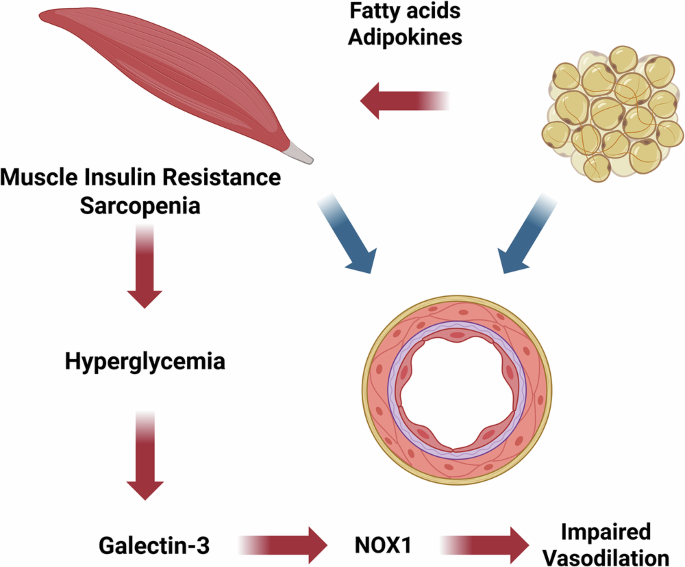
Padgett, C. A. et al. Galectin-3 mediates vascular dysfunction in obesity by regulating NADPH Oxidase 1. bioRxiv (2023).
Gustafsson, T. & Ulfhake, B. Aging skeletal muscles: what are the mechanisms of age-related loss of strength and muscle mass, and can we impede its development and progression?. Int. J. Mol. Sci. 25, 10932 (2024).
Google Scholar
Nunes-Pinto, M. et al. Sarcopenia and the biological determinants of aging: a narrative review from a geroscience perspective. Ageing Res. Rev. 103, 102587 (2025).
Google Scholar
Mirzai, S. et al. Sarcopenic obesity and cardiovascular disease: an overlooked but high-risk syndrome. Curr. Obes. Rep. 13, 532–544 (2024).
Google Scholar
Batsis, J. A., Mackenzie, T. A., Lopez-Jimenez, F. & Bartels, S. J. Sarcopenia, sarcopenic obesity, and functional impairments in older adults: National Health and Nutrition Examination Surveys 1999-2004. Nutr. Res. 35, 1031–1039 (2015).
Google Scholar
Hunter, G. R., Singh, H., Carter, S. J., Bryan, D. R. & Fisher, G. Sarcopenia and Its Implications for Metabolic Health. J. Obes. 2019, 8031705 (2019).
Google Scholar
Batsis, J. A., Mackenzie, T. A., Jones, J. D., Lopez-Jimenez, F. & Bartels, S. J. Sarcopenia, sarcopenic obesity and inflammation: Results from the 1999-2004 National Health and Nutrition Examination Survey. Clin. Nutr. 35, 1472–1483 (2016).
Google Scholar
Kim, D., Lee, J., Park, R., Oh, C. M. & Moon, S. Association of low muscle mass and obesity with increased all-cause and cardiovascular disease mortality in US adults. J. Cachexia Sarcopenia Muscle 15, 240–254 (2024).
Google Scholar
McPherron, A. C., Lawler, A. M. & Lee, S. J. Regulation of skeletal muscle mass in mice by a new TGF-beta superfamily member. Nature 387, 83–90 (1997).
Google Scholar
Schuelke, M. et al. Myostatin mutation associated with gross muscle hypertrophy in a child. N. Engl. J. Med. 350, 2682–2688 (2004).
Google Scholar
Mosher, D. S. et al. A mutation in the myostatin gene increases muscle mass and enhances racing performance in heterozygote dogs. PLoS Genet 3, e79 (2007).
Google Scholar
Grobet, L. et al. A deletion in the bovine myostatin gene causes the double-muscled phenotype in cattle. Nat. Genet. 17, 71–74 (1997).
Google Scholar
Hamrick, M. W., Pennington, C., Webb, C. N. & Isales, C. M. Resistance to body fat gain in ‘double-muscled’ mice fed a high-fat diet. Int J. Obes. (Lond.) 30, 868–870 (2006).
Google Scholar
Guo, T. et al. Myostatin inhibition in muscle, but not adipose tissue, decreases fat mass and improves insulin sensitivity. PLoS One 4, e4937 (2009).
Google Scholar
McPherron, A. C. & Lee, S. J. Suppression of body fat accumulation in myostatin-deficient mice. J. Clin. Invest 109, 595–601 (2002).
Google Scholar
Belizario, J. E., Fontes-Oliveira, C. C., Borges, J. P., Kashiabara, J. A. & Vannier, E. Skeletal muscle wasting and renewal: a pivotal role of myokine IL-6. Springerplus 5, 619 (2016).
Google Scholar
Kistner, T. M., Pedersen, B. K. & Lieberman, D. E. Interleukin 6 as an energy allocator in muscle tissue. Nat. Metab. 4, 170–179 (2022).
Google Scholar
Lin, W. et al. Functional role of skeletal muscle-derived interleukin-6 and its effects on lipid metabolism. Front Physiol. 14, 1110926 (2023).
Google Scholar
Munoz-Canoves, P., Scheele, C., Pedersen, B. K. & Serrano, A. L. Interleukin-6 myokine signaling in skeletal muscle: a double-edged sword?. FEBS J. 280, 4131–4148 (2013).
Google Scholar
Bostrom, P. et al. A PGC1-alpha-dependent myokine that drives brown-fat-like development of white fat and thermogenesis. Nature 481, 463–468 (2012).
Google Scholar
Niranjan, S. B., Belwalkar, S. V., Tambe, S., Venkataraman, K. & Mookhtiar, K. A. Recombinant irisin induces weight loss in high fat DIO mice through increase in energy consumption and thermogenesis. Biochem Biophys. Res. Commun. 519, 422–429 (2019).
Google Scholar
Hofmann, T., Elbelt, U. & Stengel, A. Irisin as a muscle-derived hormone stimulating thermogenesis–a critical update. Peptides 54, 89–100 (2014).
Google Scholar
Luo, Y. et al. Disordered metabolism in mice lacking irisin. Sci. Rep. 10, 17368 (2020).
Google Scholar
Wang, J. et al. Irisin deficiency exacerbates diet-induced insulin resistance and cardiac dysfunction in type II diabetes in mice. Am. J. Physiol. Cell Physiol. 325, C1085–C1096 (2023).
Google Scholar
Seldin, M. M., Peterson, J. M., Byerly, M. S., Wei, Z. & Wong, G. W. Myonectin (CTRP15), a novel myokine that links skeletal muscle to systemic lipid homeostasis. J. Biol. Chem. 287, 11968–11980 (2012).
Google Scholar
Little, H. C. et al. Myonectin deletion promotes adipose fat storage and reduces liver steatosis. FASEB J. 33, 8666–8687 (2019).
Google Scholar
Pelczyńska, M. et al. The role of adipokines and myokines in the pathogenesis of different obesity phenotypes-new perspectives. Antioxidants (Basel) 12, 2046 (2023).
Google Scholar
Tyrovolas, S. et al. Skeletal muscle mass in relation to 10 year cardiovascular disease incidence among middle aged and older adults: the ATTICA study. J. Epidemiol. Community Health 74, 26–31 (2020).
Google Scholar
Wilson, M. E. et al. Relationship of body composition to stress-induced pressure natriuresis in youth. Am. J. Hypertens. 17, 1023–1028 (2004).
Google Scholar
Zhu, J. et al. Follistatin improves skeletal muscle healing after injury and disease through an interaction with muscle regeneration, angiogenesis, and fibrosis. Am. J. Pathol. 179, 915–930 (2011).
Google Scholar
Butcher, J. T. et al. Effect of myostatin deletion on cardiac and microvascular function. Physiol Rep. 5, e13525 (2017).
Google Scholar
Baligand, C. et al. Functional assessment of skeletal muscle in intact mice lacking myostatin by concurrent NMR imaging and spectroscopy. Gene Ther. 17, 328–337 (2010).
Google Scholar
Qiu, S. et al. Increasing muscle mass improves vascular function in obese (db/db) mice. J. Am. Heart Assoc. 3, e000854 (2014).
Google Scholar
Tu, P. et al. Genetic disruption of myostatin reduces the development of proatherogenic dyslipidemia and atherogenic lesions in Ldlr null mice. Diabetes 58, 1739–1748 (2009).
Google Scholar
Verzola, D. et al. Myostatin mediates abdominal aortic atherosclerosis progression by inducing vascular smooth muscle cell dysfunction and monocyte recruitment. Sci. Rep. 7, 46362 (2017).
Google Scholar
Butcher, J. T. et al. Increased muscle mass protects against hypertension and renal injury in obesity. J. Am. Heart Assoc. 7, e009358 (2018).
Google Scholar
Larion, S. et al. NADPH oxidase 1 promotes hepatic steatosis in obese mice and is abrogated by augmented skeletal muscle mass. Am. J. Physiol. Gastrointest. Liver Physiol. 326, G264–G273 (2024).
Google Scholar
Rodgers, B. D. & Ward, C. W. Myostatin/activin receptor ligands in muscle and the development status of attenuating drugs. Endocr. Rev. 43, 329–365 (2022).
Google Scholar
Kwak, J. Y. & Kwon, K. S. Pharmacological interventions for treatment of sarcopenia: current status of drug development for sarcopenia. Ann. Geriatr. Med Res. 23, 98–104 (2019).
Google Scholar
Liu, X. H., Bauman, W. A. & Cardozo, C. P. Myostatin inhibits glucose uptake via suppression of insulin-dependent and -independent signaling pathways in myoblasts. Physiol. Rep. 6, e13837 (2018).
Google Scholar
Saxena, G. et al. Sex-specific increases in myostatin and SMAD3 contribute to obesity-related insulin resistance in human skeletal muscle and primary human myotubes. Am. J. Physiol. Endocrinol. Metab. 326, E352–E365 (2024).
Google Scholar
Girgenrath, S., Song, K. & Whittemore, L. A. Loss of myostatin expression alters fiber-type distribution and expression of myosin heavy chain isoforms in slow- and fast-type skeletal muscle. Muscle Nerve 31, 34–40 (2005).
Google Scholar
Dong, J. et al. Inhibition of myostatin in mice improves insulin sensitivity via irisin-mediated cross talk between muscle and adipose tissues. Int J. Obes. (Lond.) 40, 434–442 (2016).
Google Scholar
Zoico, E. et al. Myosteatosis and myofibrosis: relationship with aging, inflammation and insulin resistance. Arch. Gerontol. Geriatr. 57, 411–416 (2013).
Google Scholar