
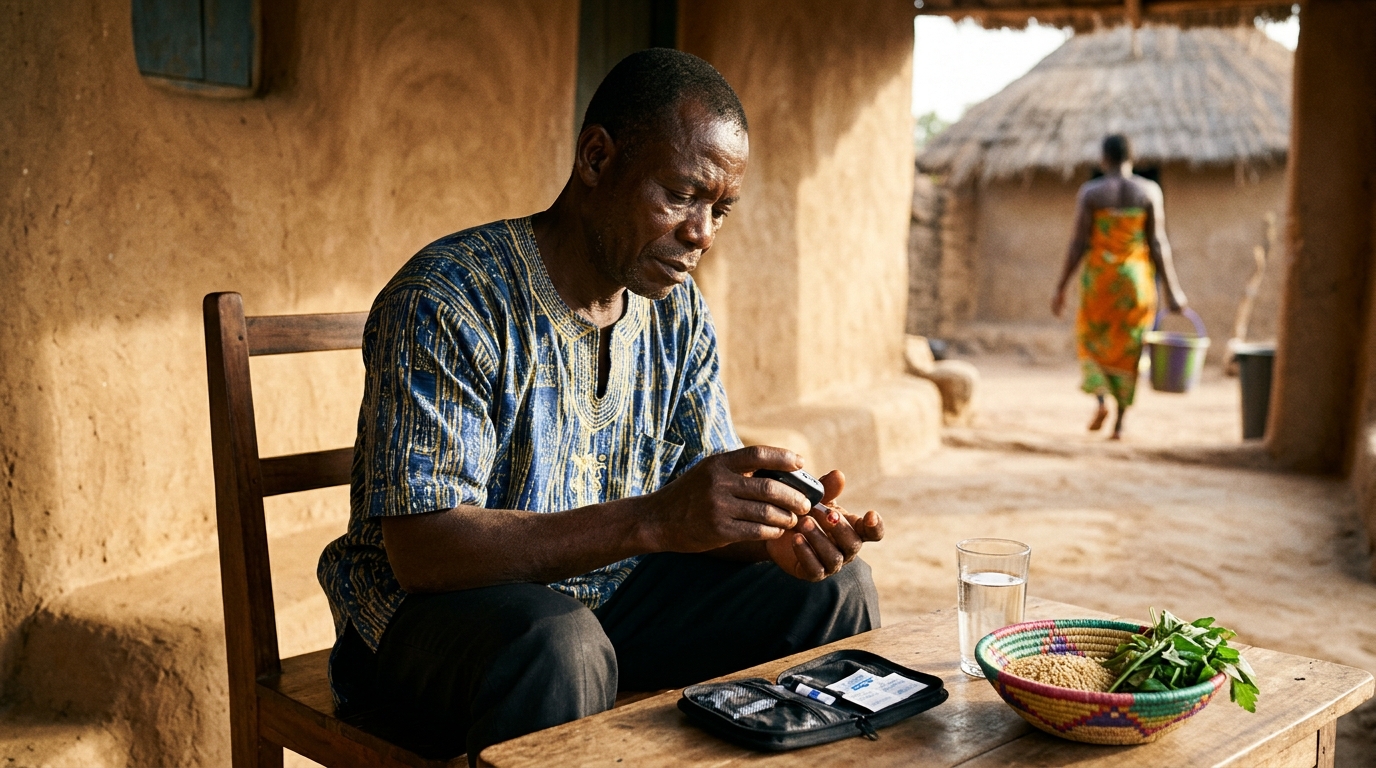
A cross-sectional investigation of 305 adults diagnosed with type 2 diabetes in Bolgatanga Municipality, Ghana, has assessed how social determinants of health influence diabetes self-management outcomes. Conducted in a low- and middle-income setting where municipal-level evidence has been limited, the research evaluated participants selected through simple random sampling to determine the proportion of individuals achieving optimal self-care practices.
Self-management practices were measured using the 16-item Diabetes Self-Management Questionnaire, with each participant’s mean score calculated across the full set of items. Researchers utilized the overall sample mean score of 3.01 as a benchmark, classifying participants with scores exceeding 3.01 as having better self-management and those scoring 3.01 or below as having poorer self-management. Under this classification, 47.9 percent of the surveyed adults demonstrated better self-management, whereas 52.1 percent exhibited poorer self-management.
The study cohort was predominantly middle-aged, representing 33.1 percent of the total sample, while women constituted 56.4 percent and married individuals made up 61.0 percent. Regarding formal educational attainment, 34.1 percent of participants had attained tertiary education. Researchers used descriptive statistics to summarize participant characteristics and self-management behaviors, applying chi-square tests and multivariable binary logistic regression with statistical significance evaluated at p < 0.05 to identify factors independently associated with self-management.
Multivariable logistic regression analysis demonstrated that sociodemographic factors and financial coverage were significantly associated with management outcomes. Widowed participants had substantially lower odds of achieving better diabetes self-management compared with single participants (adjusted odds ratio = 0.236, 95% confidence interval: 0.058 to 0.966, p = 0.045). Additionally, individuals without health insurance coverage had markedly reduced odds of better self-management relative to insured counterparts (adjusted odds ratio = 0.096, 95% confidence interval: 0.032 to 0.282, p < 0.001).
Health system characteristics and behavioural challenges also showed statistically significant associations with self-management success. Reporting high transportation costs was associated with increased odds of better self-management (adjusted odds ratio = 3.522, 95% confidence interval: 1.673 to 7.413, p = 0.001), as was experiencing long clinic waiting times (adjusted odds ratio = 2.893, 95% confidence interval: 1.459 to 5.734, p = 0.002). Conversely, encountering a lack of healthcare staff lowered the odds of better self-management (adjusted odds ratio = 0.416, 95% confidence interval: 0.222 to 0.781, p = 0.006).
Individual behavioral routines further influenced management performance, as frequent forgetfulness attributed to busy schedules was associated with reduced odds of achieving better self-management (adjusted odds ratio = 0.172, 95% confidence interval: 0.031 to 0.953, p = 0.044). The study concluded that diabetes self-management in the municipality remains suboptimal and is shaped by an interplay of socioeconomic and behavioural determinants, underscoring the need to strengthen financial protection, service delivery efficiency, and adherence support systems.
Subject of Research: Social determinants of type 2 diabetes self-management in Ghana
Article Title: Social determinants of diabetes self-management outcomes among adults with type 2 diabetes in Bolgatanga Municipality, Ghana
Article References: Adongo, F., Okyere, P., Onyin, J. K., Cudjoe, F. K., Amoakoh, M. Y., & Abdulai, T. (2026). Social determinants of diabetes self-management outcomes among adults with type 2 diabetes in Bolgatanga Municipality, Ghana. BMC Health Services Research. https://doi.org/10.1186/s12913-026-16075-9
Image Credits: AI Generated
DOI: 10.1186/s12913-026-16075-9
Keywords: type 2 diabetes, diabetes self-management, social determinants of health, Bolgatanga, Ghana, health insurance, healthcare access, Social, determinants, diabetes, self-management, outcomes