
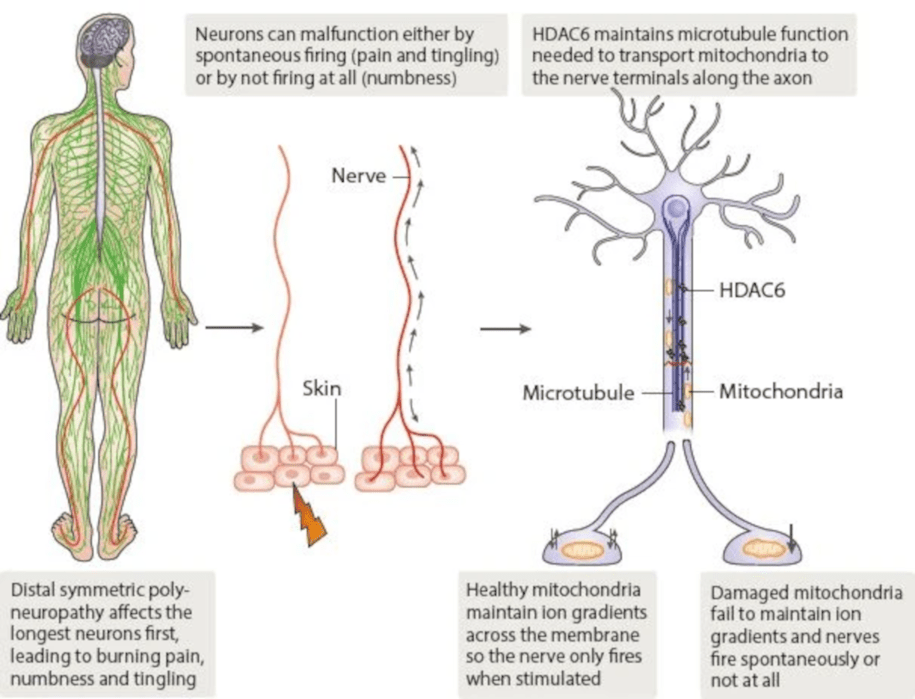
Neuropathy is one of the most common and debilitating complications of diabetes. My father and my mentor developed whole-body neuropathy over decades, and eventually died from diabetes-induced heart attacks. I manage my own neuropathy with various exercises—toe bounces, plus finger and toe clenches, a hundred at a time each, usually several times a day. That helps a lot, but it isn’t anywhere near enough.
I recently became aware of the possible medication treatments described below, and will raise this with my doctor at my next appointment.
Prevalence and risk factors of painful diabetic neuropathy: A systematic review and meta-analysis
Of the 41 studies included, the pooled global prevalence of PDPN [painful diabetes-related peripheral neuropathy] was 46.7 %. Recently, one meta-analysis provided the first pooled estimates for PDPN in patients with DM in the Middle East and North Africa region, showing a prevalence of 43.2 %, with a range from 14 to 65.3 %.
Painful diabetes-related peripheral neuropathy (PDPN) is associated with an increased risk of amputation and death [6], [7]and a higher financial burden on patients and their families due to the need for multiple pain-reducing drugs and more frequent health visits, along with reduced ability to work or perform daily activities [6], [8], [9]. Annual direct costs of care for people with PDPN were double and triple for individuals with DPN or DM alone ($27,931 vs. $12,492 and $27,931 vs. $6,632 respectively) [10].
Significant risk factors for PDPN included older age (OR = 1.02, 95 % CI, 1.01–1.04), female gender (OR = 1.58, 95 % CI, 1.19–2.11), BMI ≥ 30 kg/m2 (OR = 1.62, 95 % CI, 1.43–1.83), longer diabetes duration (OR = 1.05, 95 % CI, 1.01–1.08), and nephropathy (OR = 1.32, 95 % CI, 1.24–1.40). Targeted screening and standardized diagnostic tools are urgently needed to enhance PDPN management and mitigate its burden globally.
This, or even whole-foot amputation because of non-healing sores, is not the treatment you want.
NHS: Treatment—Peripheral neuropathy
Symptoms of peripheral neuropathy
The main symptoms of peripheral neuropathy can include:
numbness and tingling in the feet or hands
burning, stabbing or shooting pain in affected areas
loss of balance and co-ordination
muscle weakness, especially in the feetThese symptoms are usually constant, but may come and go.
Treatment
There are also some additional medicines that you can take to relieve pain in a specific area of your body or to relieve particularly severe pain for short periods.
Other problems associated with peripheral neuropathy may be treatable with medicines.
For example:
In some cases, you may need more invasive treatment, such as:
I am not recommending any of these treatments. You and your doctors need to discuss whether they are needed and which ones might be appropriate.
I have tingling in my feet, progressing to my calves, and loss of balance, and ED. I definitely need to lose weight. I will talk to my doctor about all of this at my next appointment.
Amitriptyline is used to treat symptoms of depression. It works on the central nervous system (CNS) to increase levels of certain chemicals [serotonin and norepinephrine] in the brain. This medicine is a tricyclic antidepressant (TCA).
duloxetine (Cymbalta, Drizalma Sprinkle, Irenka)
Duloxetine is used to treat depression and anxiety. It is also used for pain caused by nerve damage associated with diabetes (diabetic peripheral neuropathy).
Duloxetine belongs to a group of medicines known as selective serotonin and norepinephrine reuptake inhibitors (SSNRIs). These medicines are thought to work by increasing the activity of chemicals called serotonin and norepinephrine in the brain.
pregabalin and gabapentin (FusePaq Fanatrex, Gabarone, Gralise, Neurontin)
Gabapentin is used to help control partial seizures (convulsions) in the treatment of epilepsy. This medicine cannot cure epilepsy and will only work to control seizures for as long as you continue to take it.
Gabapentin is also used to manage a condition called postherpetic neuralgia, which is pain that occurs after shingles.
Capsaicin is used to help relieve a certain type of pain known as neuralgia (shooting or burning pain in the nerves). Capsaicin is also used to help relieve minor pain associated with rheumatoid arthritis or muscle sprains and strains. Qutenza® patch is also used to treat nerve pain caused by diabetic peripheral neuropathy of the feet. It will not cure any of these conditions.
YMMV.