
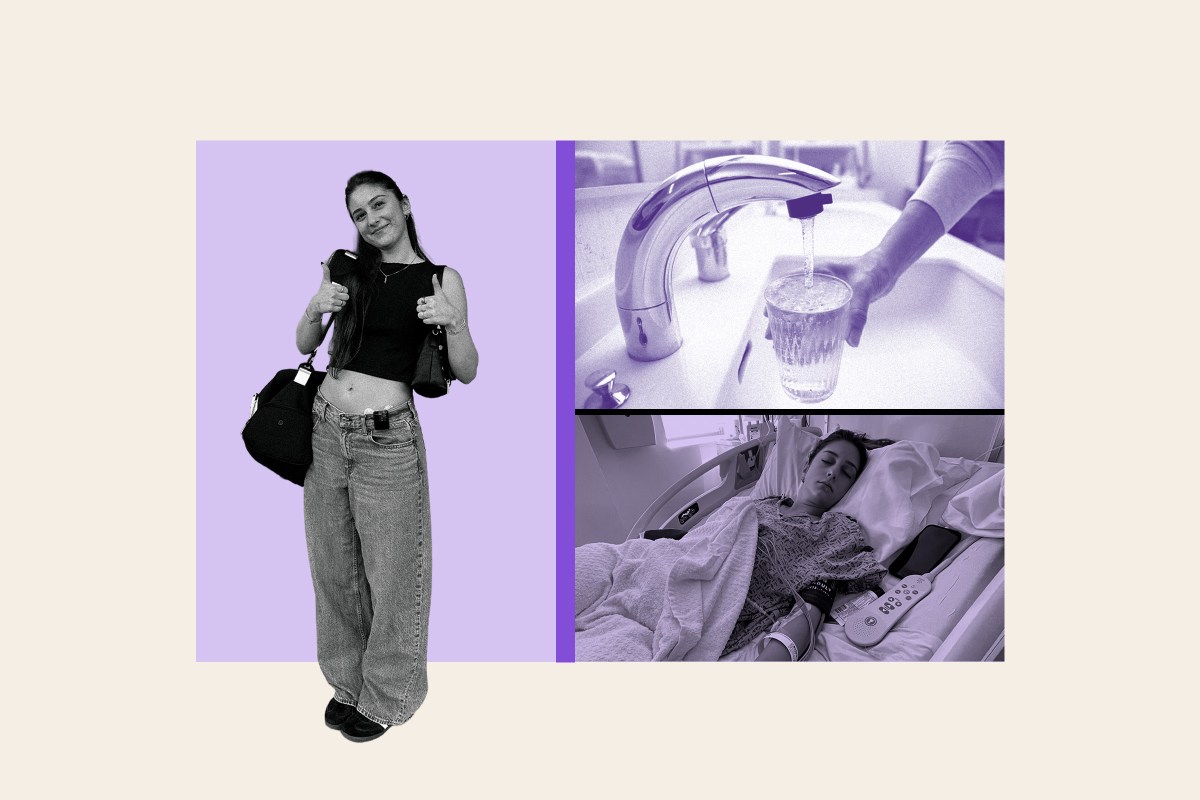
I’ve always been super healthy—the person in the friend group who didn’t get a cold even when everyone else did. I was a dancer growing up, and even after that I stayed active, working out frequently. Before my diagnosis, I was living the dream: It was during the pandemic, so I was going to college online while living in Florida. I went to the beach, I posted on social media, I got my assignments in, and that was about it. I had lost some weight, but I’d been doing lots of exercise classes on the at-home bike, and I assumed that was why. I chalked it up to being active.
At the same time, I was frequently thirsty. I’d always drank a lot of water, but it got to the point where it instilled this panic in me—I worried about access to water on airplanes or at movie theaters. If I didn’t have water next to me, I panicked. There was no time to waste between me feeling thirsty and needing water. That became more intense as time went on. I drank out of a 40-ounce water bottle. I’d drink four, five, six of those a day. That wasn’t enough, so I got this big camping jug and I’d carry that around, but it still wasn’t enough. I started having severe dry mouth as well. Even when I was drinking water, I didn’t feel quenched—it felt like there wasn’t a drop of saliva in my mouth. I googled my symptoms and right away, diabetes came up. But I told myself, “Obviously, it’s not that.”
In April 2022, I flew home to New Hampshire for my college graduation. I’d requested a specific dinner that night from a local grocery store: chicken tenders and fries. I’d been craving fried food, which was unusual for me. As I ate dinner with my parents, I told them about what I’d been experiencing—my cravings, how I’d lost weight, how hungry and thirsty I was all the time.
After dinner, I felt awful. Something wasn’t right. We were sitting in the living room and I was complaining about how it felt like I had no saliva in my mouth; it was hard to swallow. My dad, a type 2 diabetic, said, “Sometimes that happens to me when my blood sugar is high.” He asked if I wanted to use his glucometer to check my blood sugar, and I agreed. He pricked my finger for me because I couldn’t do it myself. The meter just said, “High.” I looked at my dad, bewildered. He told me to wash my hands and try again—sometimes dirty hands can cause errors. Again, it said, “High.”
“That’s weird,” my dad said. “It must not be working right.”
He checked his blood sugar; it was normal for him. My mom then checked hers; it was normal for her. My then-girlfriend, who had flown home with me, checked hers; hers was also normal.
That’s when my mom called the hospital. “It sounds like she’s in diabetic ketoacidosis,” the on-call nurse said. “That’s life-threatening. She needs to come in.”
Read More
My Turn
At the hospital, I was almost excited to play patient. I thought, “We’ll find out what’s wrong and I’ll get a little sympathy.” I didn’t know what I was walking into. What happened there is a little foggy; it feels dreamlike. There was so much going on around me. So many doctors, so many IVs, so much medical lingo. It felt very urgent. At one point, an EMT came into my room, maybe to check my blood sugar, and he lifted his shirt sleeve and showed me something attached to his upper arm. It was a continuous glucose monitor, what I wear now, but I didn’t know that at the time. He said, “I’ve been a Type 1 diabetic for years. You’re going to be fine.” That was the first time I heard Type 1 diabetes in relation to me. I was very confused in that moment.
Doctors later told me that had I not come into the hospital that night, given my A1C and blood sugar levels, I could have died. I felt like a stranger in my body. Overnight in the hospital, I researched Type 1 diabetes on social media—there were so many people just venting about how horrible this disease was. I kept thinking, “There’s no way this is my life.” That’s a big reason I decided to share my own story online: I wanted to show people what it can look like to live with Type 1 diabetes. There’s still so much stigma around diabetes. Even with diabetes in my family, I was uneducated. I didn’t know Type 1 diabetes could be diagnosed later in life. (Type 1 diabetes can be diagnosed at any age, but its first onset peak occurs between ages 4-7 and the second between ages 10-14, according to the Mayo Clinic.) I was also under the impression that Type 2 diabetics were only people who were overweight or had an unhealthy lifestyle. (While obesity is a significant risk factor for Type 2 diabetes, research from the Centers for Disease Control Prevention has shown that about 10% of Type 2 diabetics are at a normal weight.)

I was released from the hospital with a treatment plan of multiple daily injections. Type 1 diabetics’ pancreas don’t function properly and stop producing insulin, which is why we need to give ourselves insulin. Today I’m on an insulin pump and a continuous glucose monitor. I’ve learned that being a Type 1 diabetic is all-consuming. When I wake up, the first thing I do is check my blood sugar. Then I take insulin for my morning coffee. Then I watch my blood sugar to see what it does while I drink my coffee, and decide how much insulin to take for my breakfast—but that’s determined by whether I’m going to walk afterward, or if I’m going to exercise. Am I going to be sitting a lot today? What part of my cycle am I in? Have I had enough water? How much sleep did I get? All of these factors determine how much insulin I need each day. It’s constant calculations and readjustments. You start to learn patterns, but the life of just waking up and going about your day—that’s not reality for Type 1 diabetics. The dangers of not getting it right are real, especially long-term: neuropathy, kidney failure, seizures or worse.
Medicine and technology is getting better and better, which gives me hope. There’s even a new treatment that can delay the onset of Type 1 diabetes. For anyone who is where I was a few years ago, scared in that hospital room, I’d tell them that it’s important to maintain hope and take it day by day. You’ll learn this disease as time goes on, but give yourself a whole lot of grace—you’re going to need it.
This interview has been edited and condensed.
Do you have a personal essay you want to share with Newsweek? Send your story to MyTurn@newsweek.com.