
Table of Contents
Introduction
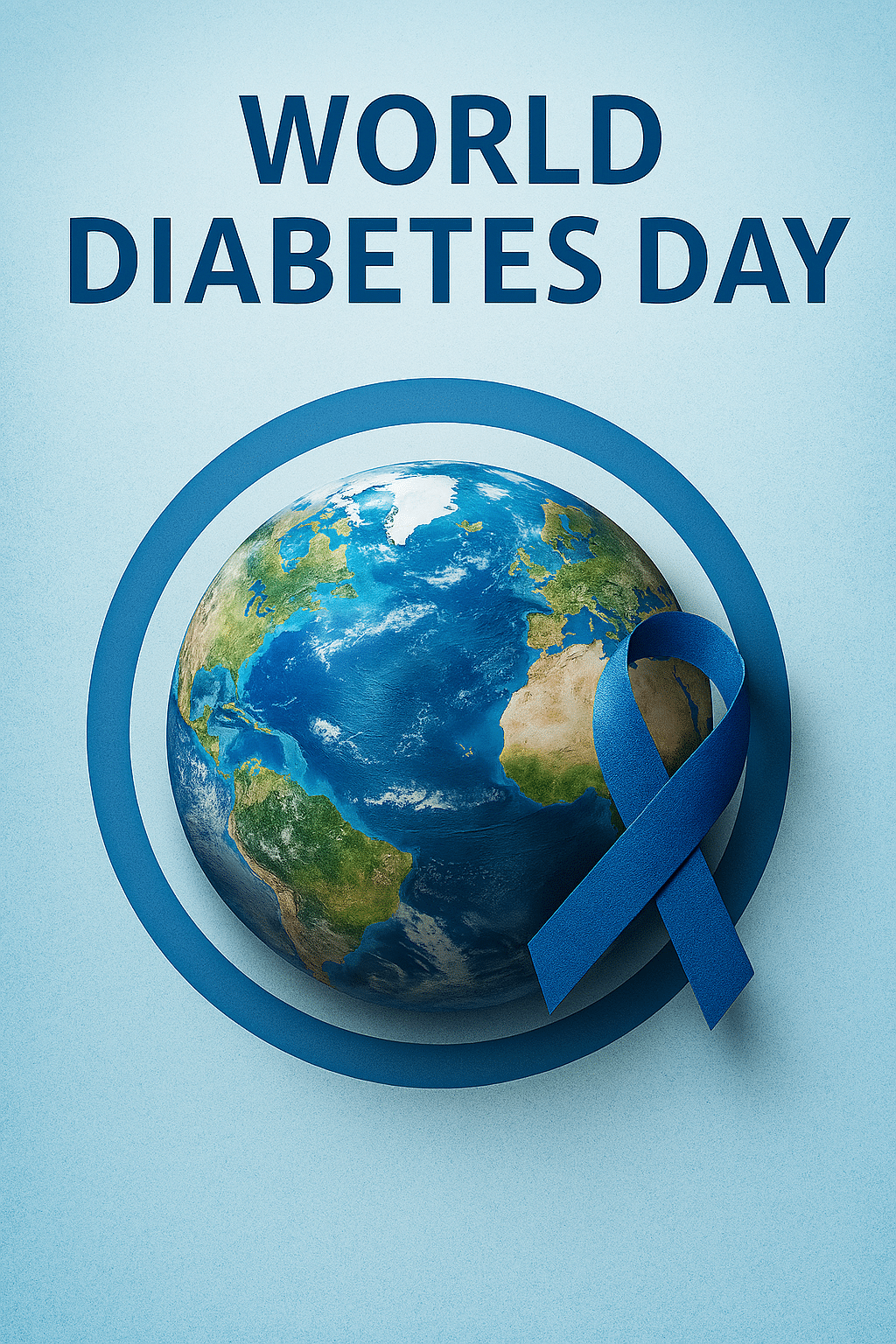
Today is World Diabetes Day. This is an annual global awareness campaign held every November 14th to highlight the global issue of the disease. The date was chosen because it is the birthday of Sir Frederick Banting, who is a Canadian physician and co-discoverer of insulin.
The global color for diabetic awareness is blue. This color is used for World Diabetes Day, as well as for Diabetes Awareness Month in November. The blue circle is the official global symbol for diabetic awareness, symbolizing unity and positivity, with the blue color reflecting the sky.
Purpose: To raise awareness about diabetes mellitus and its impact, and to emphasize the importance of prevention, diagnosis, and management. Initiation: The day was established in 1991 by the International Diabetes Federation with support from the World Health Organization (WHO). Global Reach: It is the world’s largest diabetes awareness campaign, reaching over a billion people in more than 160 countries.
Is Diabetes Preventable?
Type 2 diabetes (T2D) is preventable through lifestyle changes like maintaining a healthy weight, eating a healthy diet, getting regular physical activity, and quitting smoking. While type 1 diabetes cannot be prevented, these steps can also help manage the risk factors for T2D and delay or prevent its onset, even for those with prediabetes.
T2D
Reach and maintain a healthy weight: Losing even a small amount of weight, such as 5–10 pounds, can make a significant difference. Stay physically active: Aim for at least 150 minutes of moderate-intensity aerobic activity per week. Combining cardiovascular exercise with strength training is beneficial. Eat a healthy diet: Focus on a balanced diet rich in fruits, vegetables, and whole grains. Avoid excessive sugar and saturated fats: A diet low in these can help keep blood glucose levels stable. Quit smoking: Smoking increases the risk of high blood pressure, unhealthy cholesterol, heart attacks, and strokes.
For Those at Risk
Take steps to reverse prediabetes: Making the lifestyle changes above can help reverse prediabetes and delay or prevent the development of T2D. Monitor your health: A doctor can help you create a plan and set goals and may refer you to a lifestyle change program.
Type 1 diabetes
Type 1 diabetes is an autoimmune disease and cannot be prevented at this time. It is thought to be caused by the body’s immune system attacking itself, and known risk factors include a family history of the disease.
Quick Statistics
Globally, there are over 828 million people with the disease. In the United States, over 38 million people have the disease, which is about 1 in 10 Americans, with roughly 29.7 million diagnosed and 8.7 million undiagnosed.
Countries with the highest prevalence are Pakistan (30.8%), French Polynesia (25.2%), and Kuwait (24.9%). In contrast, countries with the highest total numbers of adults with diabetes are China (140.9 million), India (74.2 million), and Pakistan (33 million).
Global Statistics
Total: Over 828 million people worldwide have the disease. Deaths: It was the direct cause of 1.6 million deaths in 2021, and another 530,000 deaths were due to kidney disease caused by the disease. Treatment: More than half of adults aged 30 and over (59%) with the disease were not taking medication for it in 2022, a figure that was significantly higher in low- and middle-income countries.
United States Statistics
Total: Approximately 38.4 million people have the disease, representing about 11.6% of the U.S. population. Diagnosed vs. Undiagnosed: Of these, 29.7 million are diagnosed, and an estimated 8.7 million have it but don’t know it. New Cases: Each year, about 1.2 million Americans are diagnosed with the disease. Prediabetes: An additional 97.6 million American adults have prediabetes.
Which Diabetic Complication Worries YOUR State?
New data reveals which diabetic complications Americans are most concerned about, and those concerns differ by region.
Gestational diabetes ranks as the most-searched complication nationwide, dominating 17 states. Diabetic neuropathy and Hypoglycemia diabetes share the second place, showing similar interest across the 50 states. Peripheral vascular disease takes the third spot, rounding out the top three most commonly searched across states.
According to the CDC, more than 38 million Americans are living with the disease, and many face risks that impact nerves, circulation, pregnancy, and daily quality of life. To better understand these worries, ADW Diabetes analyzed Google search trends for 24 diabetic-related complications across all 50 states, using a weighted scoring system to highlight which concerns consistently rank the highest.
Key Findings:
Gestational diabetes ranks as the most prominent concern nationwide, appearing in the top five in 49 states and taking the top spot in 17 of them, including heavily populated states such as California, Texas, and New York. It also draws around 124,000 monthly searches across the U.S., showing high public interest and widespread awareness. Gestational diabetes develops during pregnancy and can affect both the mother and the baby. It is often searched by people looking for guidance on testing, diet changes, and pregnancy risks. Diabetic neuropathy shows notably high national search interest, with around 54,000 monthly searches. It consistently ranks within the top five in 48 states, taking the #1 position in Georgia, Iowa, Maryland, Michigan, Mississippi, Nevada, and South Carolina. Diabetic neuropathy causes nerve damage, often resulting in pain or numbness in the hands and feet. It is widely researched because it can impact mobility, comfort, and daily functioning. Even with modest national search volume (about 450 monthly searches), hypoglycemia diabetes shows up consistently across the country, appearing in the top five in 48 states and ranking #1 in Arizona, Louisiana, Utah, Vermont, Oklahoma, and Wisconsin. Hypoglycemia diabetes involves blood sugar dropping too low and can cause dizziness or fainting. Its sudden and unpredictable nature makes it one of the most feared day-to-day complications. Peripheral vascular disease ranks 4th overall, appearing in the top five in 42 states. It draws about 22,000 monthly searches. Peripheral vascular disease affects circulation and slows healing in the limbs. People often search for this condition when experiencing leg pain or poor blood flow related to long-term diabetes. Diabetic ketoacidosis shows strong search intensity with about 69,000 monthly searches nationwide, despite ranking 5th overall based on weighted state scores. Diabetic ketoacidosis is a medical emergency caused by very high blood sugar. Many search for early warning signs to prevent emergencies.
Roberta Kleinman, RN, M.Ed., CDE, at ADW Diabetes, an expert in diabetic education, commented on the findings:
“Macrovascular complications such as heart attacks and strokes are the leading cause of death with diabetes. Dealing with these issues early on improves your quality of life. Understanding the implications of gestational diabetes early on will help ensure a healthy pregnancy for both mother and child. Taking control of gestational diabetes may help lower the mother’s risk of developing type 2 diabetes in the future.”
“Managing your diabetes requires performing many daily tasks as well as making important decisions, which may become tedious and lead to burnout. Embrace the skills you have learned from diabetes education and stay focused on your best self-care.”
“Stay motivated by sticking to your most basic guidelines, which include eating a balanced diabetes-friendly diet, exercising daily, monitoring blood sugars, being prepared for possible low blood sugars, and taking your diabetes medications correctly.”
“Work with your diabetes team and help them to help you find solutions to your everyday fears and concerns. You can do this.”
Top 5 Most-Searched Diabetic Complications by State
Methodology
The data compiled by the ADW Diabetes Research Team analyzed 24 diabetic-related search terms using Google Trends to uncover which diabetes complications Americans are most concerned about. Searches were examined across all 50 U.S. states to identify which states search most frequently for each term and which complications consistently appeared in the top five.
Each complication was then assigned weighted points based on its ranking position (Rank 1 = 5 points, Rank 2 = 4 points, and so on) to determine the overall national ranking. This weighted approach highlights how consistently a complication ranks highly across multiple states rather than relying solely on raw national search volume, which can be skewed by population size.
Average monthly search volumes for each term were obtained from Ahrefs to provide additional context and measure public search interest.
This article was created at the WHN News Desk in collaboration with Roberta from ADW Diabetes, who are committed to consumer satisfaction and dedicated to going the extra mile in providing support for you and the entire diabetes community.
As with anything you read on the internet, this article should not be construed as medical advice; please talk to your doctor or primary care provider before changing your wellness routine. WHN neither agrees nor disagrees with any of the materials posted. This article is not intended to provide a medical diagnosis, recommendation, treatment, or endorsement.
Opinion Disclaimer: The views and opinions expressed in this article are those of the author and do not necessarily reflect the official policy of WHN/A4M. Any content provided by guest authors is of their own opinion and is not intended to malign any religion, ethnic group, club, organization, company, individual, or anyone or anything else. These statements have not been evaluated by the Food and Drug Administration.