
In this week’s issue of The Savvy Diabetic:
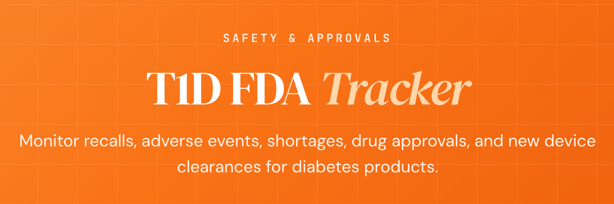
T1D FDA Tracker developed by JuiceboxPodcast
Senseonics launches Eversense 365, a year-long CGM
2026 Diabetes + Mental Health Virtual Conference, 1-2 May 2026
Abbott launches Lingo OTC CGM at Best Buy
Insulin Patch Pump Combined With CGM-Insulin Delivery Cannula
TIXiMED’s Investment from the Helmsley Charitable Trust
GentiBio First Participant Dosed in POLARIS Phase 1 Clinical Trial
Continuity Biosciences & BreakthroughT1D on NICHE® Cell-Therapy
Pancreatic Cancer Vaccine Shows Lasting Results in Early Trial
US health regulators to speed up Medicare device coverage
T1D FDA Tracker developed by JuiceboxPodcast.com, April 2026.
Check out the easy-to-use app to monitor recalls, adverse events, shortages, drug approvals, and new device clearances for diabetes products.
Access the T1D FDA Tracker: T1D FDA Tracker
Senseonics launches Eversense 365, a year-long CGM, in Europe by Sean Whooley for DrugDeliveryBusiness.com, 24 April 2026.
 Senseonics announced today that it initiated the first European launch of its Eversense 365 continuous glucose monitor (CGM). The launch comes a few months after the company picked up CE mark for the long-term, implantable CGM in January. The year-long sensor rests under the skin, meaning it can not be knocked off, minimizing inconveniences and replacement costs. In terms of comfort, users can change its gentle, silicone-based adhesive daily with almost no skin reactions.
The company said it made Eversense 365 available to the first patients in Sweden. It plans to bring the sensor to Germany, Spain and Italy in the coming weeks as well. Tim Goodnow, president and CEO of Senseonics, said: “This launch of Eversense 365 is a significant breakthrough for diabetes technology in Europe and for Senseonics as a business, as we successfully transition to an end-to-end commercial organization this year. Building on demonstrable commercial momentum in the U.S., European expansion is a key part of our Eversense 365 growth strategy, increasing our total addressable market by over 30 million patients.”
Read more: Senseonics launches Eversense 365 year-long CGM in Europe
2026 Diabetes + Mental Health Virtual Conference, an online event, May 1-2/2026.
The Diabetes + Mental Health Conference is a one-stop destination for virtual educational events focused on the intersection of diabetes management and mental health. These D+MH events bring together a cross-section of people living with all types of diabetes, their caregivers, and both medical and mental health professionals working with those with diabetes.
Fully Virtual
Two Tracks (open to everyone!)
CEU Track: for healthcare providers (earn up to 7 CEUs)
General Track: for people with diabetes (PWDs) and their loved ones
Inspiring Keynote Speakers, Sessions, Expert Panel Discussion
Product Theaters
Friday Evening “Fireside Chat” Conversations and Exhibit Hall Scavenger Hunt
Get Tickets: Join us online
Abbott launches Lingo OTC CGM at Best Buy by Sean Whooley for DrugDeliveryBusiness.com, 31 March 2026.
 Abbott launched a new bundle with Withings (Body Smart scale) for its Lingo over-the-counter glucose biosensor at Best Buy. Lingo features a biosensor and mobile app designed for customers who want to improve their overall health and wellness. The company built Lingo on its FreeStyle Libre continuous glucose monitor (CGM) technology platform. The consumer biowearable is available for consumers 18 years and older not on insulin. It tracks glucose in real time and provides personal insights and coaching. The company designed it to help people build healthy habits, retain their metabolism and improve their overall well-being.
Abbott received FDA clearance for Lingo and its Libre Rio OTC CGMs in June 2024. Lingo is one of two OTC CGMs on the market, with Dexcom’s Stelo also an option for those seeking to monitor glucose levels.
Read more: Abbott launches Lingo OTC CGM at Best Buy through Withings bundle
First in Human Feasibility Study of an Insulin Patch Pump Combined With CGM-Insulin Delivery Cannula, a study published in the Journal of Diabetes Science and Technology, 9 Aprl 2026.
 Combining a patch pump (PP) with a single-insertion glucose-sensing cannula (continuous glucose monitor with an insulin set [CGM-IS]) may reduce user burden compared with tethered insulin pumps or multiple daily injections. We aimed to determine feasibility of a combined device.
Conclusion: we have for the first time demonstrated feasibility of a PP-CGM-IS in persons living with T1D. These devices may be more acceptable to people with this condition than conventional tubed pumps or PPs with a separate sensor. Further research will be aimed at refining the device, its manufacture with an improved insertion process, greater sensor accuracy with a real-time algorithm and sensor robustness. Ultimately, the device should also include AID functionality, which represents the current standard of care.
Read more: Human Feasibility Study of an Insulin Patch Pump Combined With CGM-Insulin Delivery Cannula
TIXiMED Announces Expansion of Program-Related Investment from the Helmsley Charitable Trust by Stephen Daly, CEO of TiXiMed and published by BusinessWire.com, 13 March 2026.
 TIXiMED, Inc., a clinical-stage pharmaceutical company developing innovative therapies for diabetes based on the breakthrough discovery of the role of TXNIP in disease progression, today announced the expansion of a program-related investment (PRI) made by The Leona M. and Harry B. Helmsley Charitable Trust in furtherance of their charitable purpose. The expanded PRI, in the form of a loan, provides TIXiMED with an additional $2.2 million to support the company’s multiple ascending dose (MAD) Phase 1b clinical trial and long-term toxicology studies for TIX100, its investigational oral therapy designed to promote beta cell survival and function in individuals with Type 1 Diabetes (T1D).
“We are deeply appreciative of the ongoing interest and support from the Helmsley Charitable Trust as we advance our TIX100 program,” said Stephen Daly, Chief Executive Officer of TIXiMED. “This additional funding, bringing Helmsley’s total commitment to $4.85 million, allows us to conduct the MAD trial and to complete the necessary long-term toxicology studies. These critical steps will position the program for future clinical evaluation in people facing type 1 diabetes, bringing us closer to delivering a transformative oral therapy that addresses an underlying cause of beta cell loss.”
Read more: TIXiMED Announces Expansion of Program-Related Investment
GentiBio Announces First Participant Dosed in POLARIS Phase 1 Clinical Trial of GNTI-122 in Recently Diagnosed Type 1 Diabetes by Peg Rusconi for PRNewsWire.com, 18 March 2026.
 GentiBio, Inc., a clinical-stage biotechnology company pioneering engineered, antigen-specific regulatory T cell (EngTreg) therapies, today announced that the first participant has been dosed in POLARIS, a Phase 1 clinical trial evaluating GNTI-122, a novel single dose, autologous EngTreg investigational therapy for adults recently diagnosed with type 1 diabetes (T1D). GNTI-122 is designed to reduce or eliminate the need for life-long insulin injections in patients recently diagnosed with T1D.
“Dosing the first participant in the POLARIS trial is an important milestone for GentiBio and for the field of engineered immune tolerance,” said Mark Bach, Chief Medical Officer at GentiBio. “We are studying GNTI-122 in people recently diagnosed with type 1 diabetes, which gives us the opportunity, starting with the very first participant, to look for biological signals that targeted immune regulation may help preserve the body’s natural insulin production. We believe this approach can be transformative—and potentially curative—for people living with type 1 diabetes.”
The Phase 1 study is designed to evaluate the safety, tolerability, and key efficacy biomarkers of GNTI-122 in adults within 120 days of T1D diagnosis. The trial is enrolling at 10 specialized clinical sites with expertise in cell-based immunotherapies across the U.S., with the first patient dosed at the University of North Carolina, Chapel Hill.
Read more: GentiBio Announces First Participant Dosed in POLARIS Phase 1 Clinical Trial of GNTI-122
 Continuity Biosciences and Breakthrough T1D, the leading global type 1 diabetes (T1D) advocacy organization, today announced a strategic collaboration to advance Continuity’s NICHE® cell-therapy platform toward a planned first-in-human clinical study for people living with T1D. The effort is supported through Breakthrough T1D’s Industry Discovery and Development Partnership (IDDP) program, which funds research projects aimed at accelerating promising therapeutic programs for the treatment, cure, and prevention of T1D. If successful, the NICHE platform could represent a new delivery paradigm for cell-based therapies in T1D by enabling direct cell vascularization and localized immune protection while minimizing systemic immunosuppression.
The collaboration brings together Continuity’s expertise in implantable, precision-controlled drug delivery systems with Breakthrough T1D’s global leadership in accelerating innovation across the T1D ecosystem. The program will support IND-enabling development and a planned Phase 1/2a first-in-human clinical study of NICHE — an implantable, retrievable, and refillable extrahepatic cell-therapy platform designed to address two key challenges limiting islet transplantation: graft vascularization and immune protection.
Read more: Continuity Biosciences and Breakthrough T1D Collaborate to Advance NICHE® Cell-Therapy Platform
Investigational Pancreatic Cancer Vaccine Shows Lasting Results in Early Trial by Jim Stallard for MSKCC.org (Memorial Sloan Kettering Cancer Center), 19 April 2026.
 An experimental, individualized therapeutic cancer vaccine that uses messenger RNA (mRNA) to treat pancreatic cancer continues to show potential in a small patient group. Follow-up results from a phase 1 clinical trial show that nearly 90% of people whose immune systems responded to the vaccine were still alive up to six years after receiving the last treatment. The five-year survival rate for pancreatic cancer is around 13%, according to the American Cancer Society’s Cancer Statistics 2026 report.
“These early results show this new immunotherapy approach has the potential to make a difference for one of the deadliest cancers,” says Memorial Sloan Kettering Cancer Center (MSK) physician-scientist Vinod Balachandran, MD, the trial’s principal investigator and Director of the Olayan Center for Cancer Vaccines at MSK (OCCV). “The latest data from this small study suggest vaccines can meaningfully stimulate the immune system in some patients with pancreatic cancer — and these patients continue to do well years after vaccination.”
Why is this important? There’s a strong link between diabetes and pancreatic cancer, especially pancreatic ductal adenocarcinoma (the most common kind). About 50% of people diagnosed with pancreatic cancer also have diabetes. Type 3c Diabetes
Read more: Investigational Pancreatic Cancer Vaccine Shows Lasting Results in Early Trial
US health regulators to speed up Medicare device coverage by Ahmed Aboulenein, Sneha S K & Siddhi Mahatole for Reuters.com, 23 April 2026
 U.S. health regulators announced a new program to speed up Medicare coverage for certain medical devices on Thursday, saying it would cut reimbursement timelines to as little as two months from a year or more.
Medical device makers often face long delays between regulatory approval and Medicare reimbursement and have argued that the lack of a clear reimbursement pathway, unlike for drugs, discourages innovation and investment.
The Centers for Medicare & Medicaid Services and the Food and Drug Administration said the new RAPID coverage pathway will align regulatory review and Medicare coverage decisions for some FDA-designated Class II and Class III breakthrough devices, which typically include higher-risk medical technologies.
The agencies said the approach is designed to reduce delays between approval and reimbursement. “Under this program, CMS will be able to provide coverage within 60 to 90 days of FDA approval across the Medicare population for new devices that offer promising therapies for individuals,” CMS Deputy Administrator and Chief Policy and Regulatory Officer John Brooks told reporters on a press call.