
Table of Contents
Daria Igudesman, Laura M Nally, Alyssa A Grimshaw, Craig G Gunderson, Elizabeth G Considine, Laura M Jacobsen, Mustafa Tosur, Peter A Gottlieb, Irl B Hirsch, Lori M Laffel, Jennifer L Sherr, Chantal Mathieu, Richard E Pratley
The Journal of Clinical Endocrinology & Metabolism, Volume 110, Issue 11, November 2025, Pages 3289–3300
https://doi.org/10.1210/clinem/dgaf448
Abstract
Background
Medical nutrition therapy is fundamental for managing glycemia and weight in type 1 diabetes, yet dietary guidance specific to this population and relevant subgroups is lacking.
Purpose
We synthesized the interventional literature investigating diet patterns for glycemic and weight management in youth and adults with type 1 diabetes, with attention to interindividual variation that suggests the need for precision approaches. The protocol was prospectively registered (CRD42024519941).
Data Sources
AMED, CINAHL, Cochrane Library, Ovid MEDLINE, Ovid Embase, Google Scholar, and Web of Science Core Collection were searched from January 2011 to June 2024.
Study Selection
Clinical trials ≥4 weeks with ≥10 youth and/or adults diagnosed with type 1 diabetes ≥6 months prior and reporting glycated hemoglobin (HbA1c) or weight were included.
Data Synthesis
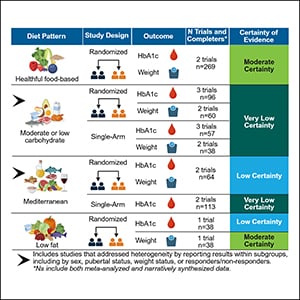
Twelve studies with 668 participants were included. Data were pooled by random-effects models for HbA1c and weight. Studies with insufficient data and subgroup differences were narratively synthesized per Synthesis without meta-analysis guidelines. Pooled results of very low to moderate certainty evidence showed no advantage of any particular diet pattern in randomized trials. Very low-quality evidence from single-arm low carbohydrate trials suggested improved HbA1c over time (−0.63% [95% CI, −0.99 to −0.27]; -6.0 mmol/mol [−10.8 to −3.0]). Wide pooled CIs suggested between-person heterogeneity; however, stratification of results by participant characteristics was rarely performed.
Limitations
Limited evidence precluded subgroup analyses to inform precision nutrition approaches.
Conclusion
Randomized trials are needed to confirm the efficacy of specific diets and determine whether precision nutrition therapies optimize glycemia and weight in persons with type 1 diabetes.