
In this week’s issue of The Savvy Diabetic:
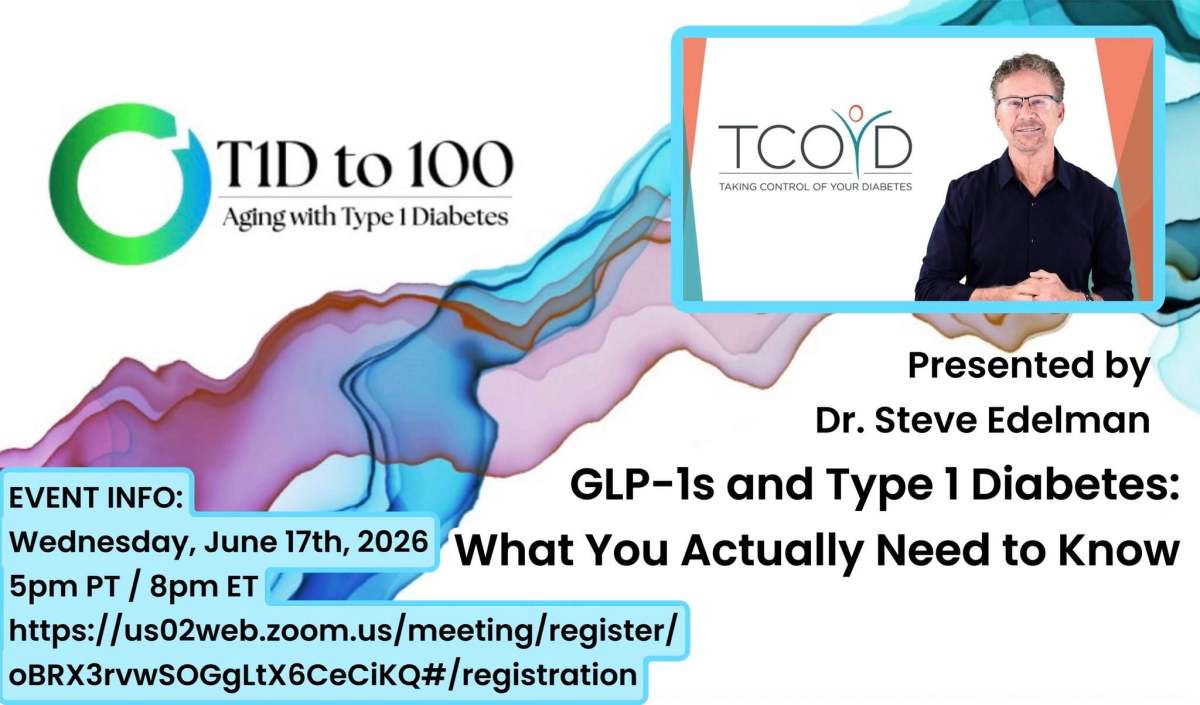
Free Important WEBINAR: GLP-1s and Type 1 Diabetes: What You Actually Need to Know with Dr. Steve Edelman, 17 June 2026
Adjunctive Treatment with GLP-1 & Dual GLP-1/GIP Receptor Agonists T1Ds
What ADA 2026 Data Reveal About Growing Gap in Ketone Monitoring
CLINICAL TRIAL: SAFEGUARD)
DLC & DPAC Applaud House Appropriations Committee for Protecting Access
Top Diabetes News: ADA 2026 by diaTribe.org
Senseonics study supports Eversense 365 CGM with AIDs
Syntax Bio Collaborates & Mayo Clinic: Pancreatic Cell Therapy for T1D
$10 spectrometer chip & real-time chemical sensing to wearables
Why type 1 diabetes is rising & what projections to 2050 tell us
Retraining the immune system to treat Type 1 Diabetes
Alexander Zverev Wins French Open 2026: Overcame T1D Diagnosis
Leaders Resign From ADA After Experts Booted From Meeting
How Healthy Are Peas?
News from T1Dto100:
Video: Let’s Learn About Life Plan Communities & T1D, 11 June 2026
Free Important WEBINAR: GLP-1s and Type 1 Diabetes: What You Actually Need to Know with Dr. Steve Edelman, 17 June 2026.
DATE: Wednesday, 17 June 2026
TIME: 5PM PT / 8PM ET
Register Here: GLP-1s and Type 1 Diabetes with Dr. Steve Edelman
We’re honored to host Dr. Steve Edelman, T1D, endocrinologist, founder of @TCOYD, who has lived with T1D himself for decades. He’ll share an honest look at what GLP-1 and other “off-label” medications mean for people with Type 1 diabetes.
There’s a BIG shift in the T1D world: for the first time ever, the ADA’s 2026 Standards of Care now officially support GLP-1 medications for adults living with type 1 diabetes and obesity.
For years, these drugs have been talked about in T1D circles but used off-label, often with a fight to get them prescribed or covered by insurance. Now the guidelines are catching up. But what does that actually mean for you and your care team?
We’ll talk about where they might fit in a care plan (weight, insulin resistance, heart and kidney health), the real risks and open questions, and what this new ADA guidance does and doesn’t change, and how to have a smart conversation with your own care team.
Yes, we’ll record the program, and post it to our YouTube Channel: https://www.youtube.com/@T1Dto100
Adjunctive Treatment with GLP-1 and Dual GLP-1/GIP Receptor Agonists for People with Type 1 Diabetes: Consensus Report, published and presented at ATTD 2026, 5 June 2026.
Among the most impactful therapeutic advances in the management of diabetes over the past two decades has been the development of incretin-based therapies, specifically glucagon-like peptide-1 (GLP-1) receptor agonists (RAs) and in combination with glucose-dependent insulinotropic polypeptide (GIP) RAs.
The purpose of this consensus report is to review the current literature and provide guidelines for diabetes clinicians and people with T1D to facilitate the safe use of GLP-1/GIP RAs in the management of T1D. This consensus statement has been endorsed by the following professional associations: Advanced Technologies & Treatments for Diabetes (ATTD), International Diabetes Federation–Europe, American Association of Clinical Endocrinologists (AACE), Breakthrough T1D, International Society for Pediatric and Adolescent Diabetes (ISPAD), Association of Diabetes Care and Education Specialists (ADCES).
Conclusions: The application of GLP-1 and GLP-1/GIP RA therapies has delivered multiple significant benefits for people with T2D since their approval and introduction, including weight loss, reduced insulin resistance, better optimized glycemic management, reduced blood pressure, and improved lipid profiles. These same benefits have been widely documented in people with T1D, yet regulatory approval for use of GLP-1 and GLP-1/GIP RAs has not been forthcoming. Although additional outcomes trials are ongoing to further investigate GLP-1 and GLP-1/GIP RA agents as adjunct therapies for people with T1D, many individuals with T1D are choosing to access these agents independently.
In this consensus report, we provide recommendations for safe and effective use of GLP-1 and GLP-1/GIP RA therapy for people with T1D, which acknowledges the need to manage AEs (Adverse Events) and titrate insulin doses to minimize risks for hypoglycemia, hyperglycemia, and ketosis. We believe access to GLP-1 and GLP-1/GIP RA therapies has the genuine potential to improve diabetes management for people with T1D, with consequent improvements in health care-related QoL and lowered risks of future complications.
Read more: Adjunctive Treatment with GLP-1 and Dual GLP-1/GIP Receptor Agonists for People with Type 1 Diabetes
Senseonics, Welldoc partner on next-gen Eversense 365 app development by Sean Whooley for MassDevice.com, 10 June 2026.
 Senseonics and Welldoc announced a strategic partnership to develop a new custom mobile application for Eversense 365. Eversense 365 is a 365-day implantable continuous glucose monitor (CGM) that rests under the skin for the duration of a year. Users can change its external, silicone-based adhesive daily with almost no skin reactions. The implant sends continuous glucose sensing data to a transmitter device attached to the patient’s skin with a silicone adhesive. This transmitter then sends the data to a mobile app, where the patient can evaluate their glucose levels and take action.
Through this partnership, Senseonics and Welldoc plan to deliver a next-generation app that retains all existing features patients currently benefit from, alongside new features to enhance the user experience and facilitate better integration with popular digital health tools. Senseonics and Welldoc plan to have the app facilitate seamless integration with Apple Health and Google Health Connect. This feature would eTagsnable users to compile their valuable health and fitness data into one place. Where available, the app will also continue to support the combination of Eversense 365 and the Sequel Med Tech twiist automated insulin delivery system. Senseonics and Sequel launched the pairing earlier this year.
The companies say users can expect a revamped app interface with improved visual components and workflows for all features. They specifically aim to enhance the user interface and experience of sensor and transmitter integration. That includes pairing and activation, communication status, synchronization, data displays and alerts.Senseonics expects the new app to launch in the U.S. in the second half of 2026. It anticipates European availability early next year. Once they launch the new app, Senseonics and Welldoc expect to work together on a cadence of future app releases. The apps leverage Welldoc’s established AI-powered platform and could eventually include CGM-informed bolus calculation, medication management, metabolic tracking and logbook and educational resources.
Read more: Senseonics, Welldoc partner on next-gen Eversense 365 app development
What ADA 2026 Data Reveal About the Growing Gap in Ketone Monitoring by Eden Miller, DO for AJMC.com (American Journal of Managed Care), 9 June 2026.
 Diabetic ketoacidosis (DKA) remains one of the most serious yet preventable emergencies in diabetes care, and new data suggest the problem is getting worse. Research presented at the American Diabetes Association’s 86th Scientific Sessions found that DKA hospitalization rates among people with type 1 diabetes rose approximately 24% between 2017 and 2024, with the sharpest increases seen in children. A separate analysis of nearly 40,000 pediatric hospitalizations found that DKA now accounts for nearly 60% of all diabetes-related hospital stays among youth, with costs reaching up to $38,000 per admission.
A key driver of that burden is recognition—or the lack of it. A study of more than 100,000 patients found that DKA is frequently difficult to identify at hospital admission because early symptoms such as nausea, fatigue, and abdominal pain overlap with common illnesses. Despite clinical guidance recommending ketone testing during periods of elevated glucose, 64% of patients do not test for ketones at all.
Dual glucose-ketone sensing represents the next advancement in diabetes care by adding visibility into rising ketone levels alongside glucose data, helping people better understand when to take action. Today, continuous glucose monitors have significantly advanced glucose management, but they don’t provide insight into ketones, which can rise even when glucose levels appear stable. Because ketones can increase quickly and lead to DKA, integrating this type of technology could support earlier recognition of risk and more timely intervention.
CLINICAL TRIAL: SAFety and Efficacy of Human Anti-thymocyte ImmunoGlobUlin SAB-142 ARresting Progression of Type 1 Diabetes (SAFEGUARD), Recruiting, 71 locations.
 This is a Phase 2b, investigator- and participant-blinded, placebo-controlled, parallel-arm study to evaluate the efficacy, safety and tolerability of SAB 142 in patients with Stage 3 New Onset of Type 1 Diabetes (NOT1D).
ClinicalTrials.gov ID NCT07187531
Sponsor SAb Biotherapeutics, Inc.
Information provided by SAb Biotherapeutics, Inc. (Responsible Party)
Last Update Posted 2026-05-29
Eligibility Criteria: Ages Eligible for Study: 5 Years to 40 Years (Child, Adult), Sexes Eligible for Study: All (See posting for other eligibility criteria and exclusions)
Read more: SAFety and Efficacy of Human Anti-thymocyte ImmunoGlobUlin SAB-142 ARresting Progression of Type 1 Diabetes (SAFEGUARD)
DLC and DPAC Applaud House Appropriations Committee for Acting to Protect Access to Lifesaving Diabetes Technology by Diabetes Patient Advocacy Coalition, 9 June 2026.
 The Diabetes Patient Advocacy Coalition and Diabetes Leadership Council applaud the House Appropriations Committee for taking an important step in protecting access to lifesaving technology for people with diabetes. Today, the committee approved its draft fiscal year (FY) 2027 Labor, HHS, Education Appropriations bill, sending it to the full House of Representatives for consideration. The report accompanying the bill directs the Centers for Medicare and Medicaid Services (CMS) to ensure Medicare beneficiaries with diabetes have reliable access to lifesaving diabetes technology while continuing to address waste, fraud and abuse within the Medicare program.
In December 2025, despite significant concerns raised by thousands of people with diabetes, DLC, DPAC and other stakeholders, CMS finalized a policy that would include continuous glucose monitors (CGMs) and insulin pumps in the Medicare Durable Medical Equipment, Prosthetics, Orthotics, and Supplies (DMEPOS) Competitive Bidding Program. DLC and DPAC remain concerned that this policy will create unnecessary and potentially dangerous disruptions in access to the technologies that people with diabetes rely on every day to administer insulin and manage their blood glucose levels.
Read more: DLC and DPAC Applaud House Appropriations Committee for Acting to Protect Access to Lifesaving Diabetes Technology
Top Diabetes News: ADA 2026 by Anna Brooks, Andrew Saintsing & Paul Heltzel for diaTribe.org, 9 June 2026.
 Big new insights on diabetes treatments and technology emerged from the American Diabetes Association’s (ADA) 2026 conference in New Orleans. Here’s what matters most for people living with diabetes. Lots of news … just a quick read/review! Topics include:
Diabetes and Weight Management Treatments
Advances in Cell Therapy
Risk Reduction and Diabetes Management Tips
Read more: Top Diabetes News: ADA 2026
Senseonics study supports Eversense 365 CGM with automated insulin delivery tech by Sean Whooley for DrugDeliveryBusiness.com, 6 June 2026.
 Senseonics announced real-world evidence supporting the performance of its Eversense 365 year-long CGM implant. Eversense 365 is a 365-day implantable continuous glucose monitor (CGM) that rests under the skin for the duration of a year. Users can change its external, silicone-based adhesive daily with almost no skin reactions. Germantown, Maryland-based Senseonics said data revealed sustained accuracy, performance and positive impact with Eversense 365 in both open-loop and closed-loop automated insulin delivery systems.
The data shared at ADA highlighted the positive real-world impact of Eversense 365. That includes a full year of strong patient adherence, glucometrics and hypoglycemic outcomes. The system also delivered a comparable adherence and outcomes between the first and second six-month period.
Dr. Francine Kaufman, chief medical officer at Senseonics, said “This real-world data showcases the positive impact that Eversense 365 is bringing to patients, regardless of their preferred treatment plan. The analysis shows Eversense 365 is delivering consistent and tangible benefits for people on either an open or closed loop system, giving patients and healthcare providers more choice and more confidence when using our differentiated CGM. This is vital because everyone’s experience with diabetes is different. Eversense 365 performs exceptionally well over an extended period and data suggests its use with twiist was favorable compared to what has been reported for other AID systems in real-world settings. We look forward to reporting more real-world evidence on Eversense and the AID combination as our user base expands.”
Read more: Senseonics study supports Eversense 365 CGM with automated insulin delivery tech
Syntax Bio Announces Collaboration with Mayo Clinic to Advance Pancreatic Cell Therapy for Type 1 Diabetes by Matt Burns for Syntax Bio and published by BusinessWire.com, 9 June 2026.
 Syntax Bio, a synthetic biology company programming next generation cell therapies, today announced a research and development collaboration with Mayo Clinic focused on advancing stem cell-derived pancreatic cell therapies for type 1 diabetes. Under the collaboration, the teams seek to define and develop an allogeneic pancreatic beta cell therapy for insulin-dependent diabetes based on patient needs. Syntax Bio plans to use its proprietary CellgorithmTM platform to guide induced pluripotent stem cells into beta cells. Mayo Clinic will provide expertise in pancreatic biology and functional testing in preclinical diabetes models to support regulatory-enabling studies and early clinical development.
“The collaboration reflects our belief that regenerative medicine must start with precise control over cell identity and function,” said John Craighead, chief executive officer of Syntax Bio. “By combining our Cellgorithm platform with Mayo Clinic’s translational and clinical expertise, we aim to accelerate the development of a next-generation cell therapy with transformative real-world benefits for patients with type 1 diabetes.”
The collaboration is focused on solving practical challenges in developing pancreatic cell therapies, including making sure the cells are the right type, function properly, can be produced consistently, and can be manufactured at scale.
Read more: Syntax Bio Announces Collaboration with Mayo Clinic to Advance Pancreatic Cell Therapy for Type 1 Diabetes
 Researchers from the University of Cambridge and GlitterinTech, a startup founded by the same research group, have unveiled a fundamentally new type of optical spectrometer that delivers laboratory-grade precision in a device small enough to be embedded in portable and wearable technologies. By rethinking how spectra are measured and processed, the team has demonstrated a spectrometer costing only around $10, operating at a centimeter scale, and capable of applications ranging from industrial quality control to real-time health care monitoring.
Optical spectrometers underpin countless technologies, from chemical analysis and manufacturing to environmental sensing and medicine. Yet shrinking these instruments has historically involved painful trade-offs: Miniaturized devices typically sacrifice bandwidth, resolution or accuracy, limiting them to rough identification rather than true metrological measurements. The newly reported convolutional spectrometer overcomes these barriers by introducing a conceptually elegant operating principle grounded in the convolution theorem, offering unprecedented performance metrics compared with existing dispersive, Fourier-transform and reconstructive spectrometers.
“The key insight was to go back to the mathematics and ask whether there was a fundamentally cleaner way to retrieve spectra,” said Dr. Chunhui Yao, a lead author of the study published in Nature Photonics.
Perhaps most strikingly, the system enabled noninvasive sensing of human biomarkers under realistic physiological conditions. Measurements of skin moisture, blood alcohol, blood lactate and blood glucose all showed high accuracy, with glucose tracking demonstrated over extended periods in a single participant. “These biomedical demonstrations are particularly exciting,” said Professor Qixiang Cheng, who led the project.
Read more: Why this $10 spectrometer chip could bring real-time chemical sensing to wearables
DID YOU KNOW? Why type 1 diabetes is rising and what projections to 2050 tell us by Diabetes Center Berne, 11 June 2026.
 For much of the 20th century, type 1 diabetes (T1D) was regarded as a relatively stable autoimmune condition. That picture has changed. Across North America and Europe, the number of children, adolescents and adults newly diagnosed with T1D has been increasing for decades and the COVID‑19 pandemic appears to have disrupted an already rising curve. With the latest IDF Diabetes Atlas (11th edition, 2025) and the Global Burden of Disease (GBD) 2021 projections to 2050, we now see a clearer, if sobering, outlook.
Two major modelling efforts suggest the same direction of travel. The GBD 2021 study projects that age‑standardised global type 1 diabetes prevalence will rise by about 23.9% between 2021 and 2050, a smaller relative increase than for type 2 diabetes, but a substantial absolute rise given the lifelong management burden of T1D. The IDF Diabetes Atlas 11 projects that overall adult diabetes prevalence (type 1 and type 2) will grow from 589 million in 2024 to around 853 million by 2050, a 46% absolute increase. While most of this growth is driven by type 2 diabetes, T1D contributes meaningfully through sustained or rising incidence in high‑income countries and improved survival, which increases prevalence even if incidence stabilises.
Why is incidence rising? T1D is a polygenic autoimmune disease in which environmental triggers act on a susceptible genetic background. Several, often overlapping, hypotheses are under investigation:
Reduced early‑life exposure to common infections (“hygiene hypothesis”), with mixed evidence.
Rising childhood adiposity and insulin resistance, which may accelerate the clinical presentation of existing islet autoimmunity (“accelerator hypothesis”).
Viral triggers such as enteroviruses and, more recently, SARS‑CoV‑2, where meta‑analyses report a 14–27% increase in paediatric T1D incidence during the pandemic.
Dietary and microbiome‑related factors, including early cow’s‑milk exposure, gluten timing and shifts in the infant gut microbiome.
Vitamin D status and latitude, endocrine‑disrupting chemicals, pollution and perinatal factors such as higher maternal age, higher birth weight and Caesarean delivery.
Three practical implications stand out for health systems, innovators and the diabetes community:
Health systems need to prepare for more people living with type 1 diabetes.
Early detection is becoming more relevant.
We still need to understand why incidence is rising.
Read more: DID YOU KNOW… why type 1 diabetes is rising and what projections to 2050 tell us?
Retraining the immune system to treat Type 1 Diabetes, posted by EurekaAlert! for FirstWordPharma.com, 3 June 2026.
 A recent study from researchers with the University of Missouri School of Medicine shows a potential way to protect the transplant without using immunosuppressive drugs. They found that modifying islets with immune-regulating molecules significantly enhanced the acceptance and survival of islet cells compared to unmodified cells.
“Immunosuppressant medications affect and weaken the whole body, so we instead focused on how we could improve our delivery of the transplanted islets,” study author Haval Shirwan said. “We provided islets with a protective shield consisting of two molecules that help the transplants evade rejection from the immune system, a solution that lengthens the survival of islet cells with minimal side effects.”
“We engineered islets with thrombomodulin and CD47. The first one prevents harmful inflammation that would otherwise contribute to early islet destruction, and the second sends a signal to immune cells that there is no threat and to ‘back off’,” study author Esma Yolcu said. “Transplanted islets engineered with both molecules had a far better survival rate than islets with only one.”
If future research trials succeed, this transplantation treatment could help patients with T1D manage their symptoms and eliminate the need for insulin shots.
Read more: Retraining the immune system to treat Type 1 Diabetes
 Alexander Zverev’s medical condition was a slight issue at the French Open 2026, when he paused to check his blood sugar levels. But he overcame the diagnosis to win the French Open, his first Grand Slam title. The German tennis pro is ranked third in the world. What is Zverev’s medical condition? He was diagnosed with Type 1 diabetes at age 4. He has turned the condition into a cause, creating a foundation to help children throughout the world.
Zverev banded with Medtronic to raise awareness of Type 1 diabetes. “Diagnosed with type 1 diabetes at just four years old, Zverev spent years hiding his condition, fearing judgment. But now, he’s turning his story into a source of strength and inspiration,” Medtronic explained.
“Becoming a professional tennis player was always my dream,” Zverev shared in an article posted by Medtronic. “Early on, I was told that competing at the highest level with diabetes was impossible — but my family and I refused to accept that. That’s why I’m partnering with Medtronic Diabetes: I want every person with diabetes to feel empowered to live the life they want.”
According to Medtronic, “In 2022, Zverev teamed up with his brother Mischa and parents, Irina and Alexander Zverev Sr., to launch the Alexander Zverev Foundation, which supports children with type 1 diabetes around the world.” Zverev’s brother and parents have also played professional tennis.
Read more: Alexander Zverev Wins French Open 2026: How He Overcame Diabetes Diagnosis
Leaders Resign From ADA After Experts Booted From Meeting by Kristina Fiore for MedPageToday.com, 8 June 2026.
 In the wake of clinicians and researchers being kicked out of the American Diabetes Association (ADA) meeting here, at least two of the organization’s leaders have resigned. President-Elect Jennifer Green, MD, and Scientific Sessions Planning Committee Chair Mark Atkinson, PhD, have both left their positions with ADA, several sources confirmed to MedPage Today. Reports of at least two additional experts abdicating their positions with ADA could not be confirmed as of press time.
The resignations come amid a flood of support for the five experts — referred to as the “New Orleans five” — who were kicked out of the meeting for sharing printed copies of an editorial in the ADA’s flagship journal Diabetes Care.
Dozens of attendees walked out of the presidential plenary on Sunday morning, during which ADA Chief Scientific and Medical Officer Rita Kalyani, MD, and ADA President of Medicine & Science Enrique Caballero, MD, were set to speak. They held a sign that read, “We stand with science.”
John Buse, MD, PhD, of the University of North Carolina School of Medicine in Chapel Hill, said Steven Kahn, MBChB, and the other four experts were quietly and respectfully handing out copies of the papers. “There were no protests, no speeches, no placards, no bullhorns,” Buse said, “but within minutes they were escorted out of the building and banned from returning.” He called on ADA to apologize to the researchers, and for attendees to applaud Kahn’s “standing up for science,” which prompted a standing ovation from the crowd
Read more: Leaders Resign From ADA After Experts Booted From Meeting
How Healthy Are Peas? by Amanda Schupak for NYTimes.com, 11 June 2026.
 The humble pea has a lot going for it. Gregor Mendel, the “father of genetics,” used pea plants to study how heritable traits were passed from parents to offspring. The plants are also friendly to the environment, with a low carbon footprint and roots that naturally nourish the soil.
And, love them or hate them, “peas are powerhouses of nutrition,” said Rebecca McGee, a plant geneticist at Washington State University.
Peas, which are members of the legume family, are high in protein and fiber, she said. And though they taste sweet, they are full of complex carbohydrates that won’t spike your blood sugar. Garden peas (also sometimes called sweet peas or English peas) are the most common type to be found in grocery stores, often sold frozen, fresh or canned. Other common varieties, usually eaten with their pods intact, are snow peas and snap peas.
Here’s a taste of what’s great about peas, no matter the variety, along with recipes from New York Times Cooking.
Peas are a good source of protein.A standard half-cup portion of cooked garden peas, for instance, contains about four grams of protein. You’ll get even more if you center them in your meal. One cup has around as much protein as you’d get from a three-ounce serving of firm tofu. A cup of cooked snow peas has about five grams of protein.
They’re packed with ‘good’ carbohydrates. One cup of cooked garden peas has about nine grams of fiber — supplying about a quarter of the 38 grams per day that is recommended for men and nearly a third of the recommended 25 grams per day for women.
They’re beneficial for your eyes.One cup of cooked garden peas has just over four milligrams of lutein and zeaxanthin, two antioxidants that are important for eye health. Research suggests that getting about six milligrams of both antioxidants from your diet each day may reduce the risk of age-related macular degeneration, a progressive eye disease that can cause blurry vision.
Read more: How Healthy Are Peas? May require subsription to NYTimes.com
News from T1Dto100: T1Dto100 Webinar: Let’s Learn About Life Plan Communities & T1D, 11 June 2026
One of our biggest concerns about aging with T1D is … Where Will We Live? What are our options?
Here’s an informative conversation about life plan communities (also known as Retirement Communities) and what they can mean for adults living with Type 1 diabetes. Whether you’re planning ahead for yourself or a loved one, this session breaks down how these communities work and what to look for. Presented by Eric Salgado, HumanGood.org, a nationwide Life Plan Community network.